Digital farming is often associated with technologies that are easy to see: drones flying over fields, sensors collecting data or robots carrying out farm operations. But some of its potential lies in something less visible: turning increasingly complex information about soils into knowledge that farmers and land managers can use.
Soil health is shaped by many interacting factors. Moisture, pH and other physical and chemical properties matter, but so do the organisms living below ground and the ecosystem functions they support. As our ability to measure these different aspects improves, the challenge is no longer only collecting data, but making sense of it and translating it into practical decisions.
Digital tools can help bridge this gap. By bringing together different types of information, they can support the interpretation of local soil conditions and connect them with possible management practices. Digital platforms can also make it easier to share knowledge and experiences between farmers, researchers and practitioners working in different regions.
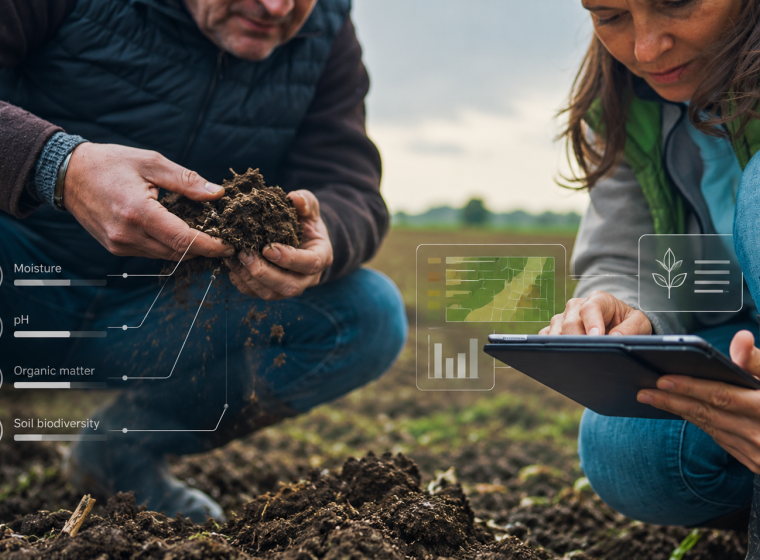
However, more data does not automatically mean better decisions. Digital tools need to be accessible, relevant to local conditions and connected to the knowledge and experience of the people using them. Their value lies not in replacing farmers' judgement, but in providing additional information that can support it.
EU-funded projects are exploring how this can work in practice. The SOB4ES project, for example, is developing the SOB4ES Booster Tool, a digital decision-support tool to help farmers and practitioners understand the soil conditions at a particular site and identify practices that could enhance soil health. Based on inputs such as location, soil moisture, pH and biological indicators, it aims to provide recommendations for soil-management practices to improve soil health. Importantly, the inclusion of biological indicators reflects the project's wider focus on soil biodiversity — an aspect of soil health that is not always captured by conventional measurements alone.
But supporting decisions at the level of an individual farm is only one possible use of digital technologies. They can also help connect what is being learned in different places. This is one of the ideas being explored in NEMESIS, where a Digital Twin is being developed alongside the project's Living Labs. The digital environment is intended to allow the Living Labs to share soil-management practices and learn from experiences across different locations. This is particularly relevant for soil management because a practice that works in one location cannot simply be assumed to work in another: soil, climate and land-use conditions differ, making the comparison of experiences across contexts an important part of the learning process.
As these approaches evolve, digital farming could give us new ways of working with the complexity of soils rather than reducing it to a handful of measurements. Bringing biological, environmental and management information together — and connecting insights from one place with experience from another — could make the diversity beneath our feet more visible, and more relevant to the choices made above ground.